Showing posts with label history. Show all posts

Monday, February 1, 2010

Una notte bolognese a Solo Bistro

Ancora Pasta and Solo Bistro once again will bring you on a gustatory fantasy ride this Thursday evening. This week's stop? Bologna!

Bologna, nicknamed La Città Rossa - The Red City - as much for its political leanings as for its distinctive red roofs, is an entirely different Italian experience from Florence, the last stop on our Ancora Pasta/Solo Bistro culinary tour of Italy. Florence is cosmopolitan, while Bologna is educated (the first university in the western world still attracts students from around the globe). Florence is Renaissance marble; Bologna is medieval brick. Florence's narrow - or sometimes nonexistent - sidewalks provide zero escape from the elements, leaving that task to the Duomo and Uffizi, undoubtedly a most culturally gratifying "escape"; Bologna, on the other hand, had the forethought to provide shelter with portico after portico after portico covering its wide sidewalks, allowing for business to continue through all the elements.

The most distinctive difference, however, is the food. Florentines are proud of their food, to be sure, but Bologna's cuisine defines its culture. We Americans grew up with baloney/bologna as a sandwich staple, no? And Chef Boyardee made a mean meat tortellini, right? And as our palates matured, we grew to appreciate spaghetti bolognese. As bastardized as these are, their roots certainly do lie in Bolognese cuisine. You simply cannot walk down a street without being subjected to the most gorgeous displays of handmade tortellini, cappelletti, and ravioli. Hundreds and hundreds of them piled in bins along the streets of the open market, in shop windows, in tantalizing restaurant displays. Cured meats, including mortadella - the Americanized version of which is, of course, baloney - hang from shop ceilings right alongside the legs of its neighbor's infamous "Prosciutto di Parma." And spaghetti bolognese? Well, you just don't serve spaghetti with a ragù alla bolognese; but you certainly would serve it with the distinctively yellow, egg-yolk-rich tagliatelle, as every Bolognese cook would.

Thus our culinary tour just had to stop in Bologna next. Watch out, though, Bolognese cuisine is deceivingly rich (Bologna is also referred to as "La Grossa" - the fat one...) - you are going to leave this meal fully satiated! Mangiate bene e buon appetito!


primo piatto
cappelletti in brodo
~ By definition, cappelletti are cheese-filled (meatless) tortellini. [The name cappelletti comes from the "hat" (cappello) shape.] Cappelletti in brodo (in broth) is a classic Bolognese first course. ~

secondo piatto
tagliatelle alla bolognese
~ The Bolognese claim tagliatelle as their own creation. Regardless of the arguments to the contrary, the Bolognese have perfected the thin, egg-yolk-rich version that we are serving this week. Presented with a traditional bolognese (hearty meat) sauce, this dish is undoubtedly the most famous of the Bolognese cuisine. ~

dolce
Zuppa Inglese

vino
tbd
~ Check back tomorrow for our update on the dessert course and wine pairing... ~

Sunday, November 15, 2009

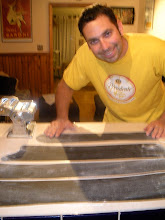
Are you really Italian, Mr. Ancora Pasta?

Timothy O'Brien. About as non-Italian a name as you can get. Followed closely by Eric, Patrick and Allen, which just happen to be Tim's brothers' names. So, why pasta and ragù and not bangers and mash? Why a glass of wine and not a pint of beer? Why guanciale and pancetta and not corned beef and blood pudding?

In his 6th grade social studies class, Tim had to design his family tree. On one side he found a very proud English lineage, as far back as you could trace. On the other he found a hodge podge of Irish (O'Brien), German (Schlager), and even Swedish (Logren). The most predominant cultural influence, however, came from his paternal grandmother's branch of the tree - the Italian branch - which was the one most recently rooted in American soil. Marini, Capone, Cardarelli, Testa, Cappabianca - these names were the ones that attracted his interest and with which he was the most familiar.

Tim's grandmother, Viola Marini, is a first generation Italian-American, whose parents arrived in this country in the early part of the last century. Her father, Cesidio, never learned English. The household was about as Italian as you can get in Quincy, MA, and the food was no exception: they made their own wine; they drank goat's milk; they ate finocchio (fennel), rather than celery, stalks; and they made pasta and sauce from scratch every Sunday. Focusing primarily on the southern Italian cuisine of Campania, from where both Cesidio's and Filomena's families had come, Filomena taught her daughters - all five of them - to appreciate and cook in the old country's ways.

Tim grew up hearing Italian, especially words associated with food, thrown around in conversation. He grew up eating things no one in Maine had ever heard of: castagne (chestnuts) every Christmas; finocchio (fennel) with cream cheese and olives as an appetizer (it was only in the last couple of years that his now-wife informed him that "normal" people eat celery with cream cheese, not fennel with cream cheese); Auntie Ellie's biscotti, Grandma Viola's green (pistachio) cake and pizzelle, and Elsa's angelonies for dessert; and homemade red sauces with homemade meatballs. He grew up surrounded by people who ate their salad as a final course, drank sambuca and grappa as after-dinner aperitifs, and who never missed an opportunity for a family gathering.

So, when Tim's senior-year history project required him to focus on one aspect of his family's cultural history, he, of course, chose to study pasta. He'd seen his grandmother make it hundreds of times before. He'd watched her hang pasta to dry on the clothes drying rack every Sunday, just like her mother had done for decades. It was a no-brainer, really. He read every pasta book he could get his hands on, picked his grandmother's brain, borrowed her bastone (rolling pin), and set out to make fresh pasta. And how did it turn out? Horrible! Awful! Gummy, sticky, a glutenous mess. His mother asked him why there were worms in the water. He may have even ruined a pot. But he was hooked.

And today? Today's pasta is a far cry from that first disastrous experience. Frankly, we think it's delicious.

Thursday, November 12, 2009

L'impasto - The dough

While I've got a few moments, I thought I'd discuss the complexity of pasta dough. Many people say, "You'll have to tell me how you make your dough," which, I would love to do, but it's just not that easy.

Virtually every type of pasta that we make has its own formula and/or feel. Naturally there are types of pasta that do use the same dough, and there are some that could use another's formula, but it just wouldn't be the same. Unfortunately for me, I'm tied to tradition. Innately, I need to make a type of pasta the way it was many, many years ago and have a very difficult time deviating from any traditional method. I admire people and companies that are able to make their mark on the pasta world by creating new products or that have an "out with the old" philosophy. Ancora Pasta is exactly the opposite: we want to go back in time and create the same pasta that my relatives made in the Old Country, which, ironically could be construed as a new product.

I'll give you an example of how one type of dough differs from another despite outwardly appearing to be very similar. Orecchiette (little ears) is a pasta that has its origins in southern Italy, and more specifically, Bari (near the little "heel"), which is where my uncle (Giacomo Cappabianca) comes from. In this area, durum-wheat (semolina) flour was, and still is, the mainstay for many pasta dough recipes. So when we make orecchiette, we need nothing more than semolina, salt, and water (a touch of wheat flour was common if handy to help soften the dough). These are the exact ingredients that are used to make cavatelli, which is very similar in shape to orecchiette. However, the difference lies in two areas: amount of flour and temperature of water. What? Temperature of water? Yes, you read correctly. The temperature of the water used in the dough-making process is crucial for many different types of dough.

Orecchiette, as mentioned earlier, has its roots in Bari, which is a small fishing city with beautiful views of the Adriatic; hence, the recommended condimento with this dish would be a great puttanesca with chunks of fish and anchovy that will easily attach themselves to the roughed-up surface or dimple on the backside of the pasta. Just like our fishermen here in Maine, a hearty dish is crucial to maintaining stamina and working through the grueling hours required to make a living.

So let's compare that to a pasta dough found farther north: garganelli, which is primarily from the Emilia-Romagna region, where some of the greatest cooking ingredients in the world originate (think parma ham & parmigiano). For this dough, let's grab some eggs, flour (tipo 00 and semolina), water, salt, nutmeg, and some grated parmigiano reggiano - one of the best cheeses in the world, so why not use it? You're already seeing the differences between the simplicity of the poorer southern ingredients and those of the more affluent province in the north (not rich by any means, just rich in resources). These of course are all combined and a dough is formed like most all other pasta doughs. The trick with this pasta is letting it dry just enough so when rolling it on il pettine ed il ferretto (the comb and iron/tool - now you're getting how we came up with the name for this blog...) it doesn't stick to the utensils. But wait! Not too dry otherwise the pasta will not stick to itself or be too brittle to work with. Oh those tricky Italians...There are actually some pictures on our Facebook page that show the garganelli being made if you care to take a look. We will be selling these at the next farmers' market. Serve this with a nice, hearty ragu, which is perfect for sticking to the ridged lines and inside the hollow tubes.

I definitely wrote more than I was anticipating, but there you have it. Two types of pasta in two different parts of the country and two completely different doughs based on local ingredients. I'll post this and see if I can figure out how to post some accompanying photos to elucidate all that was said... Ciao a tutti!