Thursday, April 22, 2010

Il Menu di Primavera Presto

Here's our latest menu for online/phone orders and reservations for our market days in Bath (finally getting outside starting on May 1st!!!).

 Pasta Ripiena:


  • Due Zucche: local butternut & acorn squashes, mascarpone, parmigiano, nutmeg, clove, sage, s&p
($8.00)

  • Carciofi: artichokes, ricotta, white wine, garlic, scallions, lemon, thyme, s&p
($8.00)

  • I’Toscano: pear, pecorino romano, ricotta, lemon zest, nutmeg, s&p
($8.00)

  • Piselli Novelli: local spring peas, local goat cheese, pecorino romano, ricotta, s&p
($8.00)

  • Spanakopita: local feta cheese, ricotta, spinach, fennel, nutmeg, s&p
($8.00)

  • Funghi: foraged Maine black trumpet mushrooms, crimini, gorgonzola dolce, parmigiano, white wine, truffle salt
($8.50)

***COMING AS SOON AS THEY START SHOWING THEMSELVES...
  • Violini: our own foraged fiddleheads, local feta cheese, ricotta, shallots, garlic, s&p
($8.00)


Arancini
Seasonally-inspired fried risotto balls with a cheese center
typically sold individually
keeps frozen for up to two months
$4.00/each

Piselli e Parmigiano: local spring peas & parmigiano stuffed w/mozzarella ($2.75)
Funghi Misti: foraged Maine mushrooms, parmigiano, stuffed w/mozzarella ($3.00)


Friday, April 9, 2010

My Modeling Photos

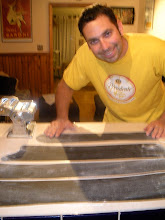
Should I put some oil on that to make it glisten? Are those too big for the photo? Do you really want my hand on that?

Ah yes, nothing like a good photography session to get the juices of life flowing again. Sort of. Anyone who knows me clearly knows I'm no model, but boy I can craft some sexy pasta - which was precisely what was being photographed. On April 6th, I had the pleasure of driving to beautiful Jefferson, ME for a food photography session with accomplished photographer, Kim Fenn, of Fenn Fotography and her associates (aka her mom & dad).

I have done food photography a few times before, and each time it sounds so simple, but somehow everything becomes as chaotic as a tourist-filled rotary. Demanding photographers, forgotten equipment, poor lighting, and the obligatory malfunctioning flash are the common ingredients for my previous shoots. Needless to say, packing up ALL of my pasta-making equipment, which currently occupies two-thirds of the square footage of my house, and driving an hour-and-a-half north was a bit trepidatious.  But I was certainly motivated by Kim's mother's promise to me that she would bake some of her infamously delicious scones - she grew up in England and knows what she's doing, unlike Dunkin' Donuts.

Anyway, oh wait - a quick aside. As much of a tangent as this is, it's analogous to my drive. Now, up in Jefferson there are many rolling hills and small little streams dotting the landscape. Being April, a few of my favorite things are coming up soon: fiddleheads and ramps. I'm always looking for other locations to forage for these ferny delights and their garlicky neighbor. So similar to a little child at Disney World, I couldn't keep my focus and kept stopping on the side of the road and running a little ways into the woods/stream/bog/etc to see if I could find any signs of fiddleheads or ramps from the previous year. Half of the locations I checked were rife with the treats (now just the patience is needed for them to show themselves). Naturally, I checked a couple others on the way home. In the rain. Happily. I love spring.

Back to photography. So we got everything set up in Teresa's (Kim's mother) large kitchen, which she ostensibly rents out for events and functions (inside joke, sorry). We quickly went through the itinerary while sipping coffee and eating scones and then got to work. Okay, not really. We ate a little bit more again.

The funny thing about food photography is that the camera quite frankly doesn't care if the food tastes good or not. It's a very difficult paradigm to go along with as a chef because there are moments when you add/subtract ingredients or cook things differently than they should, because no one is eating them. In our case though, there's not much you can do with pasta to make it look differently than it normally would, so we only made a small adjustment by adding a couple extra yolks in the dough to create a more vibrant yellow dough. Which, by the way, is certainly not out of the norm for me nor is it for the people in the Emilio-Romagna region (very yolk-rich dough). 

We took a plethora of pictures of all different shapes: filled pasta, tubular pasta, ribbon pasta, etc...We arranged them, re-arranged them, and moved them again. The itinerary we created earlier really fell to pieces, because pasta has its own schedule. Some pasta needs to dry before being shaped (garganelli),  some can't dry (cappelletti), and some needs to dry a little but not too much (ribbon pasta). The schedule became every pasta shape for themselves. Thankfully, Kim was quite flexible and worked with what was coming her way.

Lastly, I think my favorite part of the whole day was having Teresa and Herb there during the shoot. I don't think you could find nicer hosts who were also very inquisitive about the whole pasta-making process. I even got quite a few "ooohs", "ahhhs" and some "so that's how you do it" comments when I produced different shapes (which were oddly great confidence-builders). They would both help move the pasta to a different table, hold long strands of pasta, or anything else that their daughter would ask them to do (who am I kidding - tell them to do).

We figured after about six hours that there really couldn't be much that we forgot. So now we wait for the photos to be developed and we'll post a few of them. It's clear that modeling is not easy work. Thanks again to Kim Fenn, her parents, and our good friends Michelle & Poncho (and Maria)!


Friday, March 5, 2010

Farmers' Market Menu for March 6th

Tomorrow is the first Saturday of the month, which can only mean we'll be at the Bath Farmers' Market. In case you need additional incentive to venture out on a March morning, here's what we'll be offering for sale. We hope to see you there!

Pasta Fresca ~ Fresh Pasta

Capelli d’Angelo
angel hair pasta


Pappardelle senza Glutine
gluten-free pappardelle

Spaghetti alla Chitarra
“square” spaghetti

Pasta Surgelata ~ Frozen Pasta

Cappelletti Romagnoli
cheese-filled tortellini

Ravioli ai Funghi
wild mushroom ravioli

Ravioli alla Spanakopita
spinach and feta ravioli

Ravioli di Farina Integrale
whole-wheat ravioli

Ravioli di Mirtilli Rossi
cranberry ravioli

Ravioli di Tre Zucche
three-squash ravioli

Pasta Secca ~ Dried Pasta

little ears

Strozzapreti d’orzo
barley-flour nooses

 
Arancini ~ Fried Risotto Balls

Arancino di Parmigiano
parmesan

Thursday, February 18, 2010

Benvenuti al Carnevale di Venezia...

“People everywhere. Immediately off the vaporetto we were utterly, and completely enveloped by masked people, costumed people, painted people, people on stilts, winged people, intoxicated people, wigged people, and any incarnation thereof. And we, of course, got lost with all of our luggage in the middle of confusion’s masterpiece.” ~excerpt from journal

Surreal:
having the disorienting, hallucinatory quality of a dream

We thought something was suspect as the airport seemed barren of life, the vaporetti (water taxis) were empty, and one of the only other passengers on our vaporetto was dressed in flamboyant Renaissance garb. However, we were too tired to postulate; a red-eye flight, layovers, Frankfurt customs, and other joys of flying had taken their toll. Besides, I took the “T” to school, work, and my baseball games every day for four year, so passengers' oddities do not surprise me anymore. We both fell asleep as soon as we handed over our tickets and had a brief conversation with a precocious Italian toddler. All was good and right in the world: we were just minutes away from docking in Venice.

Drum beats and music seeped into our dreams. We struggled to keep our eyes open, but concluded it didn’t matter: there was a thick layer of fog masking the city; we wouldn't be able to see anything anyway. Intrigue surreptitiously goaded our consciences as we tried shaking off the weariness of travel. The syncopated drum beats were now accompanied by random outbursts from what seemed like a very large crowd. The haze of sleep slowly slipped away. We looked at each other to make sure the other was awake and we weren’t in the middle of a Shakespearean dream. Venice was finally visible - and it consisted of lots of people. The sheer number would not be known for a few more minutes, but it clearly was more than we figured was normal for a dreary February day. The piers were covered in loud decorations. The ant colony of people grew in size with each iterative blink. They all scurried about trying to find any reasonably stable and unoccupied piece of Piazza San Marco to stand on, showing off their over-the-top sartorial selections of the day - mainly distinguished, 18th-century Venetian Republic dresses, tights, wigs, and masks. 

Carrie took out her maps and I grabbed hold of the luggage. As soon as we stepped off the vaporetto and into the mass of people, Carrie grabbed hold of my arm. Pirates greeted us and slapped me on the back. Liquor spilled on my shoes. Someone grabbed my suitcase. Dogs barked. Mascots danced. The crowd counted down. An Angel flew o’er head. Confetti rained down. Masks hugged us and kissed us. For all we knew, we were the ten-millionth visitor of the day and had won a car, or better yet, a gondola. Not so. Like a running back, I lowered my head and kept forward, or to the right, or maybe we were going backwards. Each step was met with a blockade. Each glance revealed more painted individuals yelling at/to/for/with us. The vertigo settled in. We were on the set of a David Lynch movie; or perhaps this was the setting for one of Shakespeare’s murder mind-trips. I had just finished teaching Macbeth to my students before break; I figured this was ironic.

After slicing our way through Piazza San Marco, and finally being able to breathe, the next challenge awaited us: finding our hotel. Now you may not think this to be too difficult, but keep in mind that there were still thousands of people littering the very narrow streets that infamously lack order and lead to stranded tourists (just try it someday!). Streets are unnamed, numbers do not always follow a clear system, and we were unfamiliar with most of the key Venetian (Veneten) dialect terms. Remember, the unified “Italian language” (Tuscan-centric as a result of Florence's wealth and power and the writing prowess of Boccaccio and Dante) is still quite young. Most cities are unwilling to let go of their local and distinguishing dialect, as we found out the hard way in Venice. Regardless, we were tired, worn down, and about ready to give up. Our system of finding a pocket of “space” to stand and look at a map to relocate ourselves was not working. We were literally in the middle of a small alley that smelled strongly of urine (Italy is not known for its public restrooms), and was covered with confetti, booze, and a couple of passed-out “Maidens,” when Carrie looked like she was about to break down and give up.

Some things just can’t be made up, and although I enjoy writing fiction, I promise you none of this is. Very fittingly, a heavily inebriated woman asked in slurred Italian if we needed help. She swayed, barely able to stand up, with a cup in each hand. “Si, per favore signora! Grazie mille. Cerchiamo l’albergo Ca’San Marco,” I said. She handed me one of her cups, and then pointed over my shoulder and simply said, “Eccolo.” She grabbed her cup, smiled, and stumbled away. We were practically at the doorstep of this place and had passed it probably ten times. Thanks for the street names and numbers Venice. Real helpful.

That, my friends, is my all-too-true tale of arriving in Venice at the very moment that Carnevale’s opening ceremonies were commencing. The “Flight of the Angel” marks the kickoff of all Carnevale festivities each year, and as you will see in any photos you view on-line, it is a disorienting, confusing, and exciting event that draws visitors from all over Europe. Once the events quieted down a bit, we took off our newly acquired hand-made mascherette and saw the most beautiful city every constructed. I truly believe everyone should visit Venice once in their lifetime, to see a city like no other. There are no cars or buses anywhere. Walking and water taxis are the modes of transportation, or, if you’re willing to shell out 80 euro, a gondola ride. I will not attempt to describe the beauty of the city, but rather implore you to research it for yourselves on the internet or in books. Besides, food is my shtick.

Fish, bigoli, risotto, and polenta are found everywhere. And because it was Carnevale, the most amazing fried treats were insidious: frittelle. They are traditionally made with rum-soaked raisins and/or with a silky zabaglione; placed in a bag and covered with sugar. If I had a dollar for every frittella I ate... I will say that holistically, as far as the food is concerned, Venice is closer to the bottom than the top of the Italian food chain. Do not misunderstand me: Venice has wonderful food, but the variety is vastly limited due to their “island” location. However, the fish dishes, which include the jet-black squid-ink risotto with perfectly cooked calamari or cappesante (scallops) that stain your teeth, are flawless.  

A day could be made walking through the Rialto Market and looking at all the wonderful fish and spices - Venice was the largest trading port in Europe and its proximity to Middle Eastern countries explains Venice’s sometimes exotic ingredients, such as curry or cumin. But with so many sites to see in Venice, it’s hard to be pinned down to one spot for so long. Walking through Piazza San Marco (beware of the pigeons!), or in the austere Basilica, it’s easy to recognize that this city was one of extreme power and wealth. The Venetian word for gold, “oro” is found in names everywhere - from restaurants to boutiques to houses to palaces - to remind everyone of Venice’s prominent place in history.
 
And although it has nothing to do with food, I would be remiss if I did not mention how amazing the islands of Murano and Burano are - notable for their blown glass and hand-made lace. Simply amazing. Being obsessed with traditional, hand-made methods myself, these islands were a testament to artisanal practices.

This trek to the northeastern part of Italy just elucidates how different each region truly is, and Venice could be the most unique of them all in more ways than one. I hope you all get to “try” Venice, if just for a day. Just be sure to check the calendar...


Monday, February 8, 2010

Flavored Pasta Rant


So I had a conversation the other day with one of my friends about *surprise* fresh pasta. Basically, it turned in to a mini history lesson, coupled with a brainstorming session for the next market; and if not for our accompanying beer, would put many to sleep. And then, it happened. The obligatory eureka moment that always seems to find itself on a bar stool. My friend assumed that he was on to something great, something monumental. You could see the idea surfacing in a combination of excitement and deep thought. I immediately stopped talking and waited for his genius to slide off his tongue.

"Wait, wait, wait, wait. I got it. I got it. Seriously," he interrupted. "Nobody is doing this. I mean, no body. It's your in."
"Alright, what?" I asked intriguingly.
"Flavored pasta," he said matter-of-factly. He leaned back and grabbed his beer seeing it safe to sip as it was clearly my turn to comment and take that ball of fire and run with it.
"Flavored pasta?" My brows furrowed.
"Shit yeah. You said you were going to use some buckwheat flour, why stop there? Seriously. Throw some cayenne pepper in there, tumeric, curry, herbs. Whatever. Right!?" Still excited. I'm not.
"Yeah, but, cayenne pepper and --"
"And then combine all of those flavors. Hell, you could do a mexican-themed market for cinco de mayo! Then another country for their festival!"

The ideas continued to billow out - similar to when you boil milk for a beciamella and forget that it's still on the stove and it boils over making that scary hissing making you jump out of your chair thinking something's on fire. That's how excited I was.

Now, for fear of sounding "holier-than-thou" I need to say that the idea of flavoring pasta (as mentioned earlier) is a great one first and foremost. I stated in a previous post how I applaud people pushing the envelope, but I'm too tied to the traditional methods and lore surrounding "pasta." There are even a couple fresh pasta places in New England that I know of making obscurely flavored pasta.

(Here's where I play Debbie-Downer)
I hate that. I think it's bunk. It's bush-league. These flavors simply do not exist in traditional pasta. It does not even excite me for a fleeting moment. Whenever I see the myriad of flavors at these pasta stores, I basically want to throw them off of the shelves and explain to an innocent employee why these should not be here. Now here's the one caveat - if someone is not interested in the Italian pasta-making methods and really shows that they are not an Italian market place, then sure, make all the flavored pasta you want. Enjoy it with some salsa, mole, soy sauce, fish sauce, mayonnaise, or whatever. Have fun.

But we here at Ancora Pasta frown -- no, we grow angry -- no, no, no, we grow bellicose at the idea of this. We will continue flavoring pasta with only traditional accurate ingredients. Take the last market for instance. We sold trofie (has wheat bread mixed in the dough) and strascinati (saffron). Next market, we'll have some Maine-grown buckwheat flour in the dough as Italians love a hearty, nutty flour in their dough in the winter. Here are some other common ingredients mixed in traditional Italian pasta dough:
potato (gnocchi, trofie, and many many more)
parmigiano (garganelli - also uses nutmeg)
pig's blood (mostly northern areas - known as "pasta al sangue")
various flours
lard
spinach
milk
white wine
walnut oil (and other nuts)
nettles


As you can see, there are no Asian nor Mexican spices to be found. Call me boring. Give me a nice yolk-rich pasta with doppio 0 farina and some of nonna's sauce and I'm a happy man.

Monday, February 1, 2010

Una notte bolognese a Solo Bistro

Ancora Pasta and Solo Bistro once again will bring you on a gustatory fantasy ride this Thursday evening. This week's stop? Bologna!

Bologna, nicknamed La Città Rossa - The Red City - as much for its political leanings as for its distinctive red roofs, is an entirely different Italian experience from Florence, the last stop on our Ancora Pasta/Solo Bistro culinary tour of Italy. Florence is cosmopolitan, while Bologna is educated (the first university in the western world still attracts students from around the globe). Florence is Renaissance marble; Bologna is medieval brick. Florence's narrow - or sometimes nonexistent - sidewalks provide zero escape from the elements, leaving that task to the Duomo and Uffizi, undoubtedly a most culturally gratifying "escape"; Bologna, on the other hand, had the forethought to provide shelter with portico after portico after portico covering its wide sidewalks, allowing for business to continue through all the elements.

The most distinctive difference, however, is the food. Florentines are proud of their food, to be sure, but Bologna's cuisine defines its culture. We Americans grew up with baloney/bologna as a sandwich staple, no? And Chef Boyardee made a mean meat tortellini, right? And as our palates matured, we grew to appreciate spaghetti bolognese. As bastardized as these are, their roots certainly do lie in Bolognese cuisine. You simply cannot walk down a street without being subjected to the most gorgeous displays of handmade tortellini, cappelletti, and ravioli. Hundreds and hundreds of them piled in bins along the streets of the open market, in shop windows, in tantalizing restaurant displays. Cured meats, including mortadella - the Americanized version of which is, of course, baloney - hang from shop ceilings right alongside the legs of its neighbor's infamous "Prosciutto di Parma." And spaghetti bolognese? Well, you just don't serve spaghetti with a ragù alla bolognese; but you certainly would serve it with the distinctively yellow, egg-yolk-rich tagliatelle, as every Bolognese cook would.

Thus our culinary tour just had to stop in Bologna next. Watch out, though, Bolognese cuisine is deceivingly rich (Bologna is also referred to as "La Grossa" - the fat one...) - you are going to leave this meal fully satiated! Mangiate bene e buon appetito!


primo piatto
cappelletti in brodo
~ By definition, cappelletti are cheese-filled (meatless) tortellini. [The name cappelletti comes from the "hat" (cappello) shape.] Cappelletti in brodo (in broth) is a classic Bolognese first course. ~

secondo piatto
tagliatelle alla bolognese
~ The Bolognese claim tagliatelle as their own creation. Regardless of the arguments to the contrary, the Bolognese have perfected the thin, egg-yolk-rich version that we are serving this week. Presented with a traditional bolognese (hearty meat) sauce, this dish is undoubtedly the most famous of the Bolognese cuisine. ~

dolce
Zuppa Inglese

vino
tbd
~ Check back tomorrow for our update on the dessert course and wine pairing... ~

Ancora Pasta + Solo Bistro = Delicious!

Last Thursday's Ancora Pasta night at Solo Bistro went off without a hitch, at least from Ancora Pasta's (and its dining diva's) point of view. The pasta was perfect - Mrs. AP knew it would be (but you know how Mr. AP is...). But more importantly than that, it was cooked, paired, and presented perfectly, as well.

Chef Tyne did an amazing job with the brown butter, wilted arugula (I never would have thought of that and it was delicious!), and shaved pecorino romano for the chestnut ravioli. The second course was equally as yummy.

My dad was thoroughly fooled by the amount of pappardelle with pork ragù served. I agree: the bowl seemed bottomless (though we all polished the plate off, of course)! The ragù coated and stuck to the pappardelle so every bite contained smooth pasta and meaty deliciousness.

And, finally, the last course - the crostata di mele (apple tart) with homemade vanilla ice cream - was phenomenal. The crust of the crostata was super flaky, sweet, and crunchy; and the apples had been sweetened to perfection. I'll be the first to admit that I'm not really a fruit-pie person, so this dessert really took me by surprise. Kudos to Shyanne for that! The ice cream - which I'd had in its cinnamon and caramel incarnations a couple of days prior - was awesome, as well: creamy and very flavorful. All our plates were (virtually) licked clean!

I was really blown away by how everything came out. Now, I know, I'm a little biased, but don't you agree with me?

Wednesday, January 27, 2010

AP's First Restaurant Showcase

Knowing the right people pays. We may not want to admit that to ourselves or to people that, frankly, know more of the "right" people than we do. But tomorrow is a perfect example of how striking up a conversation or a friendship or a debate with one person can lead to something special.

In September, Mr. Ancora Pasta started a new job in one of the Greater Portland area's most well-known inn restaurants. At the same time, that restaurant was introducing a new sous chef, with whom Mr. Ancora Pasta found he had a great connection. They challenged each other, taught each other new techniques, and generally had a common vision for their new place of employ.

Recently, Mr. AP's new-found friend has returned to his former employer, Solo Bistro, in a new capacity: Executive Chef. In doing so he can mold an already fabulous and well-renowned restaurant's menu to fit his style. He has passion for what he does and can now truly demonstrate that passion, and his ability, in a new setting.

So how does this benefit us, the Ancora Pasta family? Well, Solo's executive chef knows well how Mr. Ancora Pasta's passion matches his own when it comes to producing a responsible, quality product and he has asked us to partake in his new vision for Solo Bistro. As part of that process, Ancora Pasta will be teaming up with Solo Bistro to create culinary tours of different regions of Italy. Each Thursday night a new region of Italy will be explored during a three-course prix fixe menu. Each course will be carefully designed to reflect the ingredients and culinary history of that region; the wines will also fit that same bill. It's a very exciting new stage in Ancora Pasta's life!

Check out this week's menu, which focuses on the cuisine of our beloved Florence. And, if you're not busy, come check us out tomorrow evening!

il menú típico fiorentine

Primo
tortelli alle castagne e miele (chestnut ravioli with honey - the chestnut honey is from Italy; we brought it back last year after we visited Florence and forgot we had it)
Secondo
pappardelle sul maiale (pappardelle with a pork ragù)
Dolce
crostata di mele (apple tart)


Information
:
Tortelli alle castagne e miele - One cannot walk down a street in Florence in the autumn or winter without seeing a vendor roasting chestnuts on a corner. The surrounding towns of Florence (specifically Ortignano Raggiolo) are responsible for producing the majority of castagne found throughout Italy and shipped here to the States. The Florentines are so passionate, they can even tell you which small town in Tuscany had the best tasting castagne, farina di castagna (chestnut flour), or miele di castagna (chestnut honey) that year! This year, my friend said it was Lunigiana.

Pappardelle sul maiale - Every city, town, neighborhood, or even street throughout Italy has its own idiosyncratic pasta shape. In Florence, the pasta of choice is clearly pappardelle. With the Tuscan region having the most abundant hunting game in Italy (most famously the cinghiale/wild boar or coniglio/rabbit), a hearty, wide strip of pasta was the best way to capture the large chunks of meat with each bite. Solo Bistro's sauce will feature pork from Squire Tarbox Farm on Westport Island.

Crostata di mele - All of the pasticciere found in Florence are filled with different forms of "pies" such as a crostata, torta, or barchetta, each being filled or covered with a seasonal fruit and/or jam, and enveloped by a sweet, crisp crust. A day in Florence is not complete without one (Mr. AP's streak is at 25 and counting!). Solo's executive chef's talented pastry-goddess wife is to thank for this delicacy!

Chianti Classico - The Tuscan region is of course synonymous with Chianti's regional wine. A Chianti Classico is strictly regulated and must be made from at least 80% sangiovese grapes found within the "old Chianti" wine region. The sangiovese grape is very sensitive to its terrain and more so than most other grapes, really gives a true sense of the soils it's grown in (calcareous soils give it the wild berry flavor; sandstone gives the flowery bouquet). Solo's owner has selected a Chianti produced by the Ricasoli family, with whom he spent some time long ago sailing along the coast of Greece (now that's a connection we'd love to have!).

Happy eating, Ancora Pasta (and Solo Bistro) fans!

Friday, January 8, 2010

Metacognitive Business

Ancora Pasta has, in large part, moved on from its "honeymoon period" at the market. We have seen encouraging signs and tasted some early success. That's not to say that we have not had to work out a few kinks and remedy some problems. Fixing problems is easy. Anyone who has had an issue with anything purchased is one more lesson for us to learn from and grow from. The hard part is imagining that someone was not able to enjoy the carefully prepared pasta as it was intended (truly hard to handle). Our goal is for that never to happen. Period. Easier said than done...

Even before Ancora Pasta started, it seemed so easy for me (Tim) to imagine: people purchase pasta and go home, cook it, enjoy it, and think how much better fresh pasta is than the $0.99 box of Mueller elbows. After all, it's pasta. Everyone has had fresh pasta before, right? My family is not the only one that constantly happens to have pasta dough hanging around "just in case", right? Everyone knows fresh pasta cooks quickly and what "al dente" is, I'm sure. What sauce goes with this you ask? - Isn't that something that you learn watching your "nonna" in the kitchen? What about thawing out the ravioli? (NO!!!) Surely, everyone knows not to do this.

But no, Tim, everyone does not know all of that.

Learning how to make pasta correctly, check that, *perfectly*, was a travail in and of itself lasting many years, but is now as easy as toasting bread. Selling it and explaining how to cook it is something completely different. Some of the issues we have come across are all a direct result of me taking a few things (aforementioned) for granted. We all assume everyone knows how to make a peanut-butter & jelly sandwich because we have all grown up with this. My assumption that everyone has had fresh pasta cooking experience was misguided. As a former English teacher, I had to teach students proper citation in research papers which dealt largely with the paradigm of "common knowledge." If it's common knowledge (i.e. Lincoln was assassinated), you do not need to cite it. Many students had problems (like me!) getting out of their minds, and into the collective minds of our society.

We at Ancora Pasta have revised a few instructions, commenced the writing of a "sauces" recipe flip book (salsa alle noce anyone?), and added a couple more ravioli to each package (not everyone eats the pasta as a "primi" as we do). These changes, along with adding a few other items to our repertoire will surely continue our quest to spread the wonders of pasta to all parts of Maine, all the while, helping us grow our business conscientiously and sustainably.

Friday, December 18, 2009

Menu for 12.19

Menu della Festa (Natale) ed il Mercato...

Paste Ripiene / Stuffed Pasta

*Ravioli alla Rucola: Baby arugula from Squire Tarbox Farm, goat cheese from Appleton Creamery, ricotta, pecorino, and walnuts

*Fagottini al I'Toscano: pear, pecorino romano, and ricotta "purses." We discovered these at our favorite restaurant in Florence, I'Toscano.

*Ravioli con Mirtilli Rossi: Goat cheese from Appleton Creamery, cranberries from Sparrow Farm, orange zest, and our own thyme

*Ravioli ai Funghi: foraged Maine black trumpet and hedgehog mushrooms from Oyster Creek, oyster mushrooms, sauteed with shallots and butter, gorgonzola dolce, parmigiano

*Ravioli ai Porri: white wine braised leeks and fennel from Level 3 Farm, ricotta, pecorino romano, a bit of lemon and a dash of hot pepper

*Ravioli di due Zucche: roasted butternut and delicata squashes from Level 3 Farm and Goranson's Farm, mascarpone, parmigiano, nutmeg, and a dash of clove

*Ravioli la dolce vita: nutella, mascarpone, wrapped inside a sweetened pasta dough


Pasta Fresca / Fresh Pasta
*Spaghetti alla Chitarra *Linguine


Pasta Secca / Dried Pasta
*Our special Christmas blend of green, white, and red Orecchiette

Thursday, December 3, 2009

Our first Holiday Menu and a quick glimpse of the Holidays...

Holiday events are just around the corner - if not closer - and there's nothing that typifies a family gathering more than a nice, big spaghetti dinner (of course, ravioli are a perfectly acceptable substitute!). It never sounds all that enticing to have 15 people crammed around a table meant for 8. You kind of need to sit sideways just so that your arm has enough space to flex, and to provide a nook for your other arm to rest while nearly sealed to your oblique - unusable. You look around quickly, and everyone else looks the same - one-armed bandits wearing a smattering of faded red and green attire with the obligatory snowflake somewhere on them. But finally, you situate yourself right in the middle of the table for prime pasta real estate. It's about to pay dividends. Go ahead, reach out and get it started...You grab the over-sized bowl of fresh spaghetti, which may as well be a wash basin it's so big, and start pulling it towards you. And then -

Papa: Aspetta la nonna!
You: Dov'e lei?
Fratello #1: E al piano di sotto...*sigh*
You: Perche?! Ho molto fame!
Cugino: Porta piu salsa per Zio Giacomo.
Fratello #2: Ogni anno! Sempre lo stesso!
Papa: Sta' zitto!
Mama: Basta! Lei viene adesso...
Nonna: Giacomo -Che hai voluto? Ho dimenticato.
Tutti: Oh madonna...

And that's just the first course. Let the Holidays begin... :-)


Menu
Paste Ripiene / Stuffed Pasta
*Ravioli ai funghi: foraged Maine black trumpet mushrooms, oyster mushrooms, crimini mushrooms sauteed with shallots and butter, gorgonzola dolce, parmigiano

*Ravioli di porri: braised leeks and fennel from Level 3 Farm, ricotta, pecorino romano

*Ravioli di due zucche: roasted butternut and delicata squashes from Level 3 Farm and Goranson's Farm, mascarpone, parmigiano, nutmeg, and a dash of clove

*Cappelletti Romagnolo: creamy italian cheese (burrata), nutmeg, lemon zest stuffed in a "tortelloni" (no meat = cappelletti). This type of pasta is a traditional Christmas pasta that will be a small-batch production of Ancora Pasta due to the difficulty in procuring burrata. First come first served for ordering!

*Fagottini al I'Toscano: pear, pecorino romano, and ricotta "purses." We discovered these at our favorite restaurant in Florence, I'Toscano.


Paste Fresche / Fresh Pasta
*Spaghetti alla chitarra
*Linguine
*Mafaldine


Paste Secche / Dried Pasta
*Orecchiette (most likely these will be available as red pasta and/or green pasta, as well. We'll
color the pasta according to the season!)
*Pici
*TBA


Saturday, November 28, 2009

Thanksgiving, Ancora Pasta Style

We all know that Thanksgiving is the American food holiday. This year, because of Mr. Ancora Pasta's "real" job as a cook in the Maine Dining Room at the Harraseeket Inn in Freeport, ME, whose Thanksgiving buffet is enjoyed by over 800 people, the Ancora Pasta family is celebrating the holiday bit by bit over a whirlwind four-day period filled with food and family. Undoubtedly unsurprising to those who know us, this year's Thanksgiving meals feature Ancora Pasta's ravioli. Mr. Ancora Pasta was inspired by the traditional, seasonal flavors of Thanksgiving and created five different ravioli to be sold at the Bath Winter Farmers' Market. (Luckily Mrs. Ancora Pasta got to taste test each one...it's important to keep your better half happy, as I'm sure you already know.)

The first, and most common (though by no means common), was his Ravioli di Due Zucche: roasted delicata (from Goranson Farm, also at the BWFM) and kuri squashes with mascarpone cheese. This was the first, and only, ravioli we offered at our first farmers' market and it went like hot cakes! We sampled it out with a little EVOO, s&p, and some freshly grated nutmeg. Even at room temperature they were to die for!

At the second farmers' market we introduced our second ravioli, a dried Maine cranberry- and goat cheese-filled delicacy: Ravioli con Mirtilli Rossi e Formaggio di Capra. We got our cranberries from Sparrow Farm, who is at the BWFM, too. This is a little sweeter than your typical ravioli and will be an awesome addition to our Thanksgiving-Sunday supper tomorrow! (My dad, Ancora Pasta's own walking advertisement, is overjoyed that he was finally able to lay his hands on some of these ravioli as I previously sold the packages he'd reserved right out from under his nose!)

Mr. Ancora Pasta's favorite ravioli, the one he waxes most poetic about, is the Ravioli ai Funghi - Mushroom Ravioli. These are made with oyster mushrooms and locally foraged black trumpet mushrooms from Oyster Creek Mushroom Company (from my hometown of Damariscotta!). Mr. AP paired the mushrooms with a gorgonzola dolce, a softer, sweeter version of the strongly flavored blue cheese we commonly see here in the U.S. These ravioli are earthy and delicate and absolutely amazing.

The ravioli I provided for my Thanksgiving-day meal with my family was the Ravioli di Due Stagione (Two-Season Ravioli), named for its use of seasonal ingredients: maple syrup (spring) and acorn squash (fall), both from Goranson Farm. The maple syrup was a congratulations gift from my dad upon our highly successful first farmers' market, and the acorn squash was given to us in a trade between farmers' market vendors. (This act of trading among vendors is a nice little tradition at the farmers' market and certainly helps our goal of using as many products from the farmers' market as possible.)

And, last, but not least, the Ravioli alle Castagne. These chestnut ravioli were served today at our more "Italian" Thanksgiving brunch with Mr. Ancora Pasta's family. Chestnuts are one of those special treats common in his family's winter gatherings and there was no way we could overlook the perfect combination of nutty flavor and soft bite these nuts provided. Today we served them with a salsa alle noci, a light walnut and Tuscan cheese sauce. They were gobbled (ha!) up in minutes!

We anticipate many more types of ravioli and other stuffed pastas at upcoming farmers' markets. Christmas will feature new fillings such as a savory pear and pecorino cheese and a chocolate peppermint (dessert, anyone?). What would YOU like to see on our Christmas list?

Wednesday, November 18, 2009

10 Reasons I Love Being Mrs. Ancora Pasta

In no particular order, here are the top 10 reasons that my role as Mrs. Ancora Pasta works for me...

* I never have to eat store-bought pasta. Or store-bought sauce, for that matter.

* Mr. Ancora Pasta was in charge of making the pasta course at our wedding...I didn't have to lift a finger and could focus on stressing about everything else.

* I get to taste test approximately one thousand different types of pasta paired with multiple sauces prior to sale.

* I often come home from work to find dinner (aka today's taste-test) all ready to be finished and/or heated up.

* We go to Italy. And we go to Italy to eat. Oh, we also see sites; look at beautiful, ancient things; take tours of food-production factories, farms and kitchens. But mostly we eat and spend the majority of our not-eating time figuring out where and what we will eat next.

* A meal at my house is never more than 10 minutes away as we always have pasta and the fixings for a sauce.

* My husband sweeps every day. Mostly because there's always a thin film of flour on the floor from pasta-making, but I don't care why he does it.

* I get to eat the most original combinations of ingredients for stuffed pastas - pretty much whatever my heart desires. Roasted chestnut with mascarpone? Sure. Lobster with hollandaise? Of course! Pea puree and pancetta? Heck yeah.

* I never have to think about what to bring to a pot-luck, family gathering, or office party. Delicious fresh pasta anyone?

* My friends and family won't stop telling me how to-die-for Ancora Pasta (and, by default, its producer) is. And who doesn't love to hear how great their husband is?

Sunday, November 15, 2009

Are you really Italian, Mr. Ancora Pasta?

Timothy O'Brien. About as non-Italian a name as you can get. Followed closely by Eric, Patrick and Allen, which just happen to be Tim's brothers' names. So, why pasta and ragù and not bangers and mash? Why a glass of wine and not a pint of beer? Why guanciale and pancetta and not corned beef and blood pudding?

In his 6th grade social studies class, Tim had to design his family tree. On one side he found a very proud English lineage, as far back as you could trace. On the other he found a hodge podge of Irish (O'Brien), German (Schlager), and even Swedish (Logren). The most predominant cultural influence, however, came from his paternal grandmother's branch of the tree - the Italian branch - which was the one most recently rooted in American soil. Marini, Capone, Cardarelli, Testa, Cappabianca - these names were the ones that attracted his interest and with which he was the most familiar.

Tim's grandmother, Viola Marini, is a first generation Italian-American, whose parents arrived in this country in the early part of the last century. Her father, Cesidio, never learned English. The household was about as Italian as you can get in Quincy, MA, and the food was no exception: they made their own wine; they drank goat's milk; they ate finocchio (fennel), rather than celery, stalks; and they made pasta and sauce from scratch every Sunday. Focusing primarily on the southern Italian cuisine of Campania, from where both Cesidio's and Filomena's families had come, Filomena taught her daughters - all five of them - to appreciate and cook in the old country's ways.

Tim grew up hearing Italian, especially words associated with food, thrown around in conversation. He grew up eating things no one in Maine had ever heard of: castagne (chestnuts) every Christmas; finocchio (fennel) with cream cheese and olives as an appetizer (it was only in the last couple of years that his now-wife informed him that "normal" people eat celery with cream cheese, not fennel with cream cheese); Auntie Ellie's biscotti, Grandma Viola's green (pistachio) cake and pizzelle, and Elsa's angelonies for dessert; and homemade red sauces with homemade meatballs. He grew up surrounded by people who ate their salad as a final course, drank sambuca and grappa as after-dinner aperitifs, and who never missed an opportunity for a family gathering.

So, when Tim's senior-year history project required him to focus on one aspect of his family's cultural history, he, of course, chose to study pasta. He'd seen his grandmother make it hundreds of times before. He'd watched her hang pasta to dry on the clothes drying rack every Sunday, just like her mother had done for decades. It was a no-brainer, really. He read every pasta book he could get his hands on, picked his grandmother's brain, borrowed her bastone (rolling pin), and set out to make fresh pasta. And how did it turn out? Horrible! Awful! Gummy, sticky, a glutenous mess. His mother asked him why there were worms in the water. He may have even ruined a pot. But he was hooked.

And today? Today's pasta is a far cry from that first disastrous experience. Frankly, we think it's delicious.

Thursday, November 12, 2009

L'impasto - The dough

While I've got a few moments, I thought I'd discuss the complexity of pasta dough. Many people say, "You'll have to tell me how you make your dough," which, I would love to do, but it's just not that easy.

Virtually every type of pasta that we make has its own formula and/or feel. Naturally there are types of pasta that do use the same dough, and there are some that could use another's formula, but it just wouldn't be the same. Unfortunately for me, I'm tied to tradition. Innately, I need to make a type of pasta the way it was many, many years ago and have a very difficult time deviating from any traditional method. I admire people and companies that are able to make their mark on the pasta world by creating new products or that have an "out with the old" philosophy. Ancora Pasta is exactly the opposite: we want to go back in time and create the same pasta that my relatives made in the Old Country, which, ironically could be construed as a new product.

I'll give you an example of how one type of dough differs from another despite outwardly appearing to be very similar. Orecchiette (little ears) is a pasta that has its origins in southern Italy, and more specifically, Bari (near the little "heel"), which is where my uncle (Giacomo Cappabianca) comes from. In this area, durum-wheat (semolina) flour was, and still is, the mainstay for many pasta dough recipes. So when we make orecchiette, we need nothing more than semolina, salt, and water (a touch of wheat flour was common if handy to help soften the dough). These are the exact ingredients that are used to make cavatelli, which is very similar in shape to orecchiette. However, the difference lies in two areas: amount of flour and temperature of water. What? Temperature of water? Yes, you read correctly. The temperature of the water used in the dough-making process is crucial for many different types of dough.

Orecchiette, as mentioned earlier, has its roots in Bari, which is a small fishing city with beautiful views of the Adriatic; hence, the recommended condimento with this dish would be a great puttanesca with chunks of fish and anchovy that will easily attach themselves to the roughed-up surface or dimple on the backside of the pasta. Just like our fishermen here in Maine, a hearty dish is crucial to maintaining stamina and working through the grueling hours required to make a living.

So let's compare that to a pasta dough found farther north: garganelli, which is primarily from the Emilia-Romagna region, where some of the greatest cooking ingredients in the world originate (think parma ham & parmigiano). For this dough, let's grab some eggs, flour (tipo 00 and semolina), water, salt, nutmeg, and some grated parmigiano reggiano - one of the best cheeses in the world, so why not use it? You're already seeing the differences between the simplicity of the poorer southern ingredients and those of the more affluent province in the north (not rich by any means, just rich in resources). These of course are all combined and a dough is formed like most all other pasta doughs. The trick with this pasta is letting it dry just enough so when rolling it on il pettine ed il ferretto (the comb and iron/tool - now you're getting how we came up with the name for this blog...) it doesn't stick to the utensils. But wait! Not too dry otherwise the pasta will not stick to itself or be too brittle to work with. Oh those tricky Italians...There are actually some pictures on our Facebook page that show the garganelli being made if you care to take a look. We will be selling these at the next farmers' market. Serve this with a nice, hearty ragu, which is perfect for sticking to the ridged lines and inside the hollow tubes.

I definitely wrote more than I was anticipating, but there you have it. Two types of pasta in two different parts of the country and two completely different doughs based on local ingredients. I'll post this and see if I can figure out how to post some accompanying photos to elucidate all that was said... Ciao a tutti!


Wednesday, November 11, 2009

Who is Ancora Pasta?

Ancora Pasta is a family-run business that prides itself on producing fresh, dried, and frozen artisanal pasta the way it has been for centuries: by hand. You will not find heavy machinery here; just a pair of hands and old-fashioned pasta tools - some of which emigrated from Italy and have been passed down by our relatives.

Ancora Pasta is about as family-run as you can get. We are just two people, a husband and wife team, assisted by our friends and family on a volunteer (or "for pasta") basis. Tim, our pastaio (pasta man), is the culinary heart of the business. Carrie is the organizational center and administrative expert-in-training.
Our goal is to create a traditional regional-Italian pasta experience using ingredients that are local (to Maine, of course!), organic, and seasonal. This is not your standard American pasta dinner, by any means. The majority of types of pasta we make aren't even found in your average grocery store, let alone the state of Maine. You'll find that our pasta is not "cut and dried," so to speak. Each has been chosen carefully for its distinct form, texture, and, believe it or not, history (Tim is a big pasta historian). We want you to taste and feel how pasta is meant to be, not what we've been encouraged to believe it to be through our "fast-food" culture.